
The long-term and systematic consequences of structural racism can be difficult to see, quantify, and convey. However, the online tool developed by Jaime Madrigano, an associate professor of environmental health engineering at the Johns Hopkins Bloomberg School of Public Health, aims to do all three.
With “Environmental Racism: A Tool for Exploring the Permanent Legacy of Redlining in the Urban Environment,” users correlate 14 contemporary environmental indicators with the practice of “Redlining” in the 1930s. Can be visualized.
Redlining “discriminatory practice of denying access to loans to neighbors considered” dangerous “due to minority and immigrant population proportions, poor housing stock, and other factors.” was. A colleague of RAND Corporation. Neighboring areas fall into one of four categories: Type A (highest), Type B (still desirable), Type C (certainly declining), Type D (danger), with corresponding color codes green, blue, It was yellow and red. Respectively. The category was created by a homeowner loan company with the support of the Federal Government. The lender made the lending decision using the company code and similar tools. As a result, people living in the “Type D” neighborhood were denied access to mortgages and other financial opportunities.
“We keep conversations away from environmental disparities due to race and income, Action That led to them. These are intentional actions, policies and practices that have long-term economic and health implications. ”
Jaime Madrigano
Associate Professor, Department of Environmental Health Engineering
“These practices have had a lasting effect,” says Madrigano. “We couldn’t access home ownership because certain populations didn’t have access to mortgages. This is the way most Americans build personal and intergenerational wealth. These practices are It has brought about persistent poverty and a systematic and disproportionate burden that plagues the same. Population, many times. “
With this tool, users can get a map of the National Archives depicting one of the approximately 200 communities in the United States where redlining data is available, and current environmental hazards such as air pollution, green spaces, and other environmental indicators. And can be combined with equipment patterns.
The tool documentation cites literature linking these environmental factors to the associated health effects. For example, it cites several studies that show a strong association between exposure to air pollution and shortened life expectancy, respiratory and cardiovascular disease.
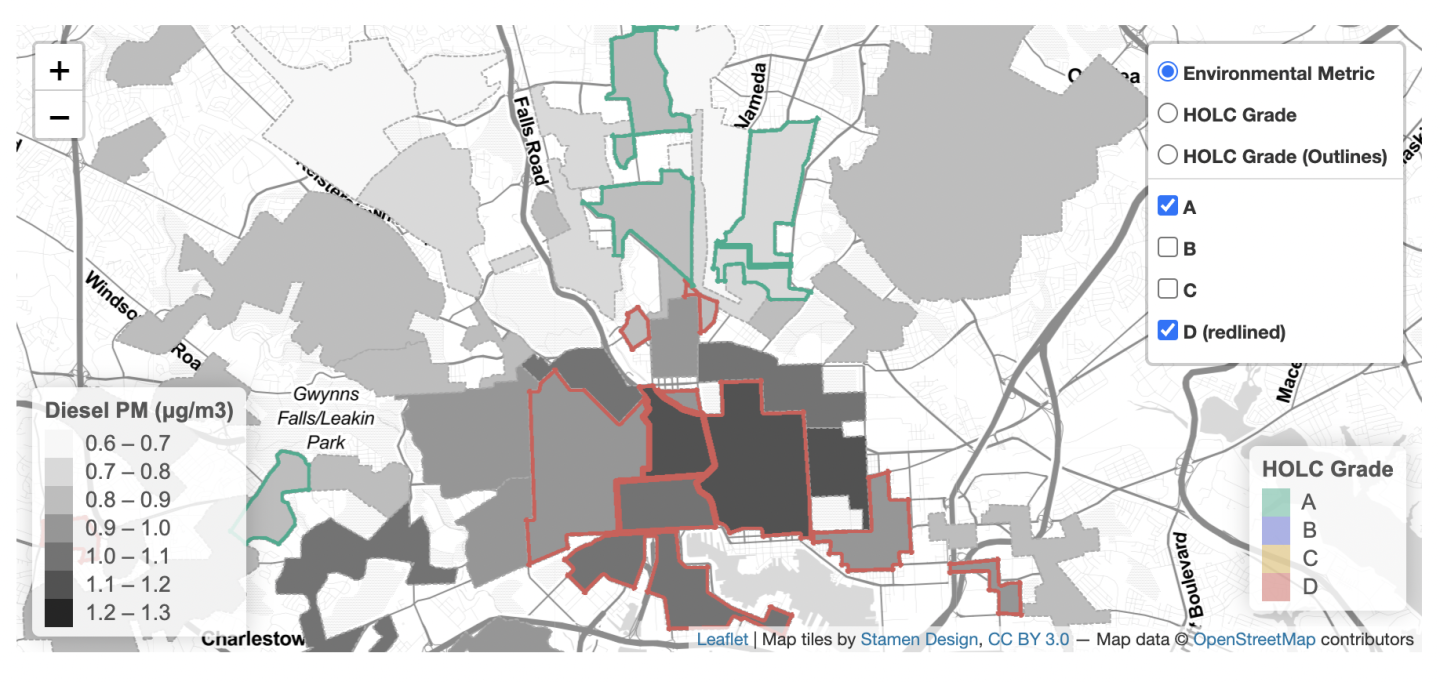
Image caption: The map shows that the lowest rated areas under homeowner loan companies (enclosed in red) have the highest exposure to diesel particulate matter, but homeowner loan companies (enclosed in red). The area with the highest rating under (surrounded by green) is the experience with the least exposure to diesel particulate matter.
image credit: Environmental Racism: A tool for exploring the lasting heritage of redlining in the urban environment
Madrigano and her team deliberately included the term “environmental racism” in the title of the tool. She defines this concept as an unfair distribution of environmental load and comfort brought about by deliberate past and present policies and practices.
“When you hear that word, some people become bristle,” says Madrigano. “But we keep the conversation away from racial and income environmental disparities, Action That led to them. These are intentional actions, policies and practices that have long-term economic and health implications. “
For Madrid, the most important point from tools is that environmental hygiene is intertwined with housing, transportation, infrastructure, and planning issues, and tools like her educate users about their connections. She feels it helps to do.
“Environment, sustainability and climate change are global issues that require multiple sectors and stakeholders to be at the table,” says Madrid. “Today, when we talk about environmental health disparities, we want to think about deliberate actions that can undo those unjustified burdens.”
Commentaires
Enregistrer un commentaire