
In the latest webinar hosted by AMC Bridge, a panel of experts explored the role of simulation techniques in accurate modeling of products, systems and processes.
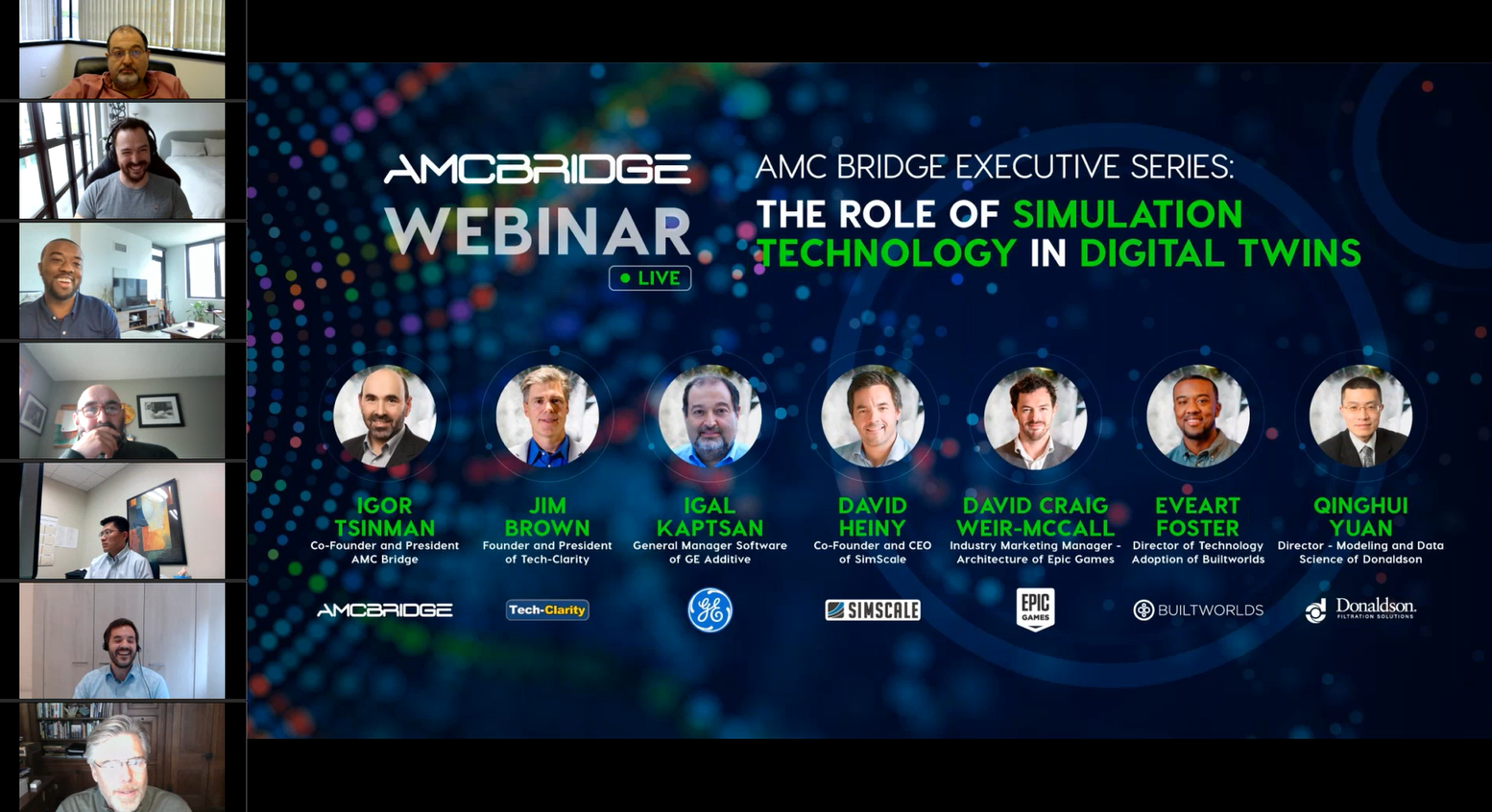
At the latest AMC Bridge Executive Series webinar in April, a panel of industry experts gathered to discuss the important role of simulation technology in accurate modeling within digital twins.
The panel contained the following: David Heiny, co-founder and CEO of SimScale. David Weir-McCall, Industry Marketing Manager – Epic Games Architecture. Eveart Foster, Director of Technology Recruitment at Built Worlds. Igal Kaptsan, general manager software for GEAdditive. Igor Tsinman, co-founder and president of AMC Bridge. Qinghui Yuan, Director of Modeling and Data Science at Donaldson. The webinar was moderated by Jim Brown, the founder and president of Tech-Clarity.
Why are digital twins so important?
It is clear that companies can benefit a lot from the successful implementation of digital twins. These benefits include improved product development processes, deeper insights into system or building performance, and a comparison of the “design-time” and “manufacturing-time” states of a product or building.
Are Digital Twins Worth Without Simulation Techniques?
Including simulation as part of a digital twin plays an important role in predicting the performance and reliability of a product or system. Simulation also affects many other aspects of the product or system life cycle, such as energy efficiency, buildability or manufacturability analysis, and long-term cost of ownership predictions. As a result, it raises an important question: “Is the digital twin worthwhile independent of simulation?”
Epic Games’ David Weir-McCall says, “There’s a lot of value in places where simulation isn’t needed. Areas such as capturing and storing historical and current data, managing operational performance, and real-time system monitoring” are all digital twins. A product lifecycle that benefits from use but does not require simulation. “Historical data can be used to inform future design decisions,” he added.
Donaldson’s Qinghui Yuan suggested that combining the use of artificial intelligence and machine learning with data science can derive significant value from historical data captured by digital twins.
In the construction industry, Builtworlds’ Eveart Foster suggested using the data captured and contained in the digital twins as a benchmarking tool for job progress to help avoid errors and prevent redoing due to errors.
With so many paths to pursue, it’s clear that digital twins are included to provide significant business value, with or without simulation.
“Overall, the idea of a digital twin is like a journey. Simulation can be a step in that journey, but there are many steps,” says Tsinman.
The first thing to establish when deploying a digital twin is the business goal of that digital twin.
“In a sense, we all use digital twins, but we’re not aware of that,” Kaptsan said. “There are systems that can be controlled from anywhere, such as smart homes and devices.”
How can I get more value from a digital twin using simulation?
Simulation can be used in combination with digital twins to improve innovation in ways such as validating design decisions, saving development time by improving validation, and improving products through optimization. However, it is also useful during the operational phase of products, equipment, systems, buildings, or other assets.
Where do you think companies are trying to increase the value of digital twins with simulation technology?
Kaptsan said that from a 3D printing perspective, it is impossible to complete a binder jet printing project without simulation. This is because the scaling and sintering process requires simulation to print the model accurately, which improves results and reduces the need for reprinting.
Eveart Foster endorsed the idea that simulation with twins would be very useful in the building construction industry. Concepts such as energy modeling from a 3D BIM model to simulate the amount of energy required for a building will be implemented for over 10, 20, and 30 years.
In addition, the ability to analyze scan and surface data provides valuable insights into the volumetric requirements of materials such as concrete needed to achieve certain parts of the building process.
David Heiney of Simscale quoted an interesting use case for simulating a digital twin on a “city scale”. By simulating the effects of wind conditions, cities can significantly improve their ability to anticipate and prepare for natural disasters such as hurricanes. Combining historical data with live data collected by instrumentation throughout the city enables accurate modeling of different conditions, planning and even avoiding the dramatic effects of natural disasters. Useful for.
The panelists agreed that the value of the digital twin is well established and that the role that simulation can play in increasing its value is important. When a company decides to implement a digital twin, it is clear that it must first establish business goals and then decide how to proceed.
What is the first step to focus on deriving more value from twins in simulation?
Keeping in mind that deploying a digital twin is like a journey, Tsinman points out that at first a digital twin could be a “digital copy of a physical object” and data about the product. And proposed to collect as much data as possible from the product as one important step. Building or system as much as possible. Without data, historical and live digital twins can be worthless and simulations are useless. Igor suggested that it would be wise to start small and plan the process carefully.
Originally, companies may consider hybridizing data and simulation, suggesting that using artificial intelligence and machine learning early in the process will provide greater value in the long run.
What does the poll say?
When an organization is asked to share why digital twins are important, the audience is between the desire to drive the company’s ongoing improvement initiatives and the desire to improve design and design-related decisions. So I showed a fairly even division of 33%.
Another 25% of participants said that monitoring and improving product, system, or building performance was the most important benefit to their company. Clearly, design communication is not as important to these companies as these other benefits.
AMC bridge
Headquarters (USA): contact@amcbridge.com
UK office: andyph@amcbridge.com
www.amcbridge.com
YouTube
Commentaires
Enregistrer un commentaire